
You’ve probably noticed that building impressive shoulders isn’t as straightforward as it seems—well, maybe that’s because most people don’t approach it like a proper construction project. Think of your deltoids as the framework of a house: you need solid foundations in all three sections to create that powerful, well-balanced structure. I’m not entirely sure why, but dumbbells offer something barbells simply can’t match when it comes to shoulder development, and once you understand the blueprint…
Some of the links in this article may be affiliate links. If you make a purchase through these links, we may earn a small commission at no extra cost to you. Thank you.
Understanding Shoulder Anatomy and Function

Your shoulders are basically the workhorses of your upper body – they’re involved in practically every movement you make with your arms. Think of them like a ball-and-socket joint, similar to a universal joint on a driveshaft – it gives you incredible range of motion but isn’t the most stable connection. You’ve got four rotator cuff muscles that act like guy-wires on a tower, keeping everything stable. The deltoids are your main movers, shaped like triangular caps covering the joint. Well, they’re what give you that broad-shouldered look when properly developed through consistent training.
The Role of Rotator Cuff Muscles in Shoulder Stability

While the deltoids get all the glory when it comes to shoulder workouts, the rotator cuff muscles are actually doing the heavy lifting when it comes to keeping your joint stable and injury-free. Think of them as your shoulder’s foundation crew – they’re not flashy, but without them, everything falls apart.
These four muscles work like a support system around your shoulder blade:
| Muscle | Primary Job | Why It Matters |
|---|---|---|
| Supraspinatus | Stabilizes during movement | Prevents shoulder impingement |
| Infraspinatus | External rotation | Essential for throwing motions |
| Subscapularis | Internal rotation | Largest rotator cuff muscle |
Key Shoulder Muscles for Dumbbell Training
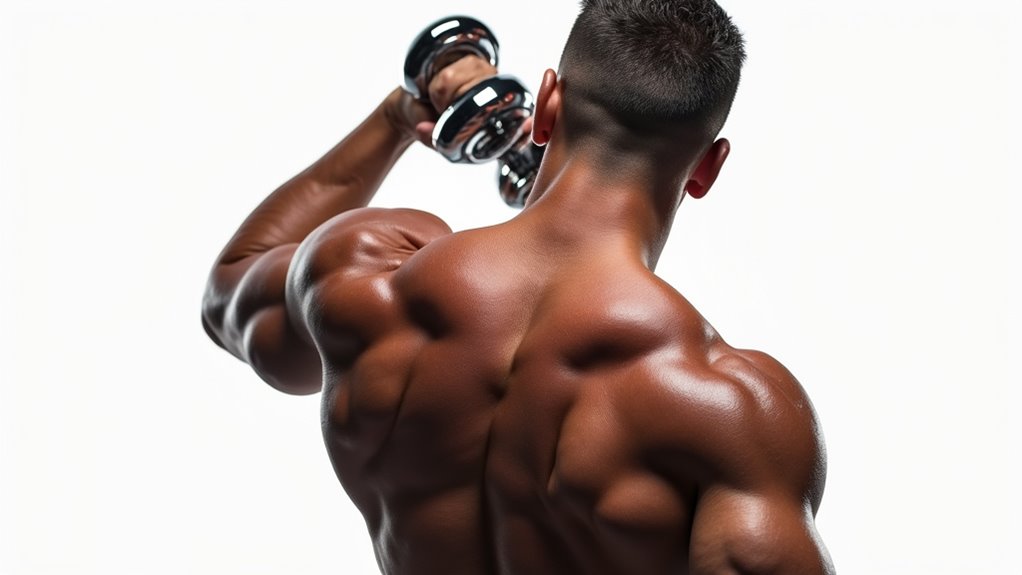
Now that we’ve covered your shoulder’s support crew, let’s talk about the main players you’ll actually be working when you grab those dumbbells. Your deltoids are like the foreman of the job site – they’re the big, triangular muscles that cap your shoulders and do most of the heavy lifting. You’ve got three sections: front, middle, and rear delts. Think of them as your power tools for pressing, raising, and pulling movements. The front deltoids handle overhead presses, while your rear delts – well, they’re probably the weakest link that needs the most attention.
Mastering the Seated Dumbbell Shoulder Press
Since you’ve got the foundation knowledge of shoulder anatomy under your belt, it’s time to tackle what I consider the bread and butter of shoulder training – the seated dumbbell shoulder press. This exercise is like the hammer of shoulder workouts – simple, reliable, and gets the job done every time.
Start by sitting on a bench with dumbbells at shoulder height, palms facing forward. Press straight overhead until your arms are fully extended, then lower back down with control. The seated position keeps you stable, so you can focus on pure shoulder strength without worrying about balance.
Essential Dumbbell Exercises for Complete Shoulder Development
Building a complete set of shoulders isn’t just about hammering away at one exercise – you need a toolbox of movements that hit every angle, just like framing a house requires different tools for different jobs. You’ll want to grab your dumbbells and work through lateral raises for width, bent-over reverse flies for rear delts, and Arnold presses for that overhead power. Don’t forget upright rows – they’re solid for building thickness. Mix in some shrugs too. Each exercise targets different muscle fibers, so you’re fundamentally building from the ground up.
Advanced Dumbbell Movements for Maximum Shoulder Growth
When you’ve mastered the basics and your shoulders can handle serious load, it’s time to step into the heavy-duty zone where the real growth happens. You’ll want to tackle compound movements that’ll challenge multiple muscle groups simultaneously. Think of it like upgrading from a hand drill to a pneumatic hammer – you’re working smarter, not just harder. The dumbbell push press becomes your best friend here, engaging your core and legs to drive those weights overhead. Arnold presses will torch your deltoids while improving shoulder mobility. These movements separate the weekend warriors from serious builders.
Safety Tips and Best Practices for Shoulder Workouts
All that power you’re building means nothing if you end up sidelined with an injury – and trust me, shoulders are probably the most finicky joints you’ll deal with in your entire body.
Think of your shoulder like a golf ball sitting on a tee – it’s not exactly locked in tight. Here’s how you’ll keep those joints happy:
- Start every session with proper warm-up movements and light weights
- Never let your ego pick the weight – your form should stay perfect
- Stop immediately if you feel sharp pain or unusual discomfort
- Progress gradually by adding small weight increments weekly
- Cool down with gentle stretches to maintain flexibility
About The Author


