
Building a strong back is like constructing a solid foundation for a house—you need the right tools and technique. Most folks think they need heavy weights or fancy gym equipment, but honestly, resistance bands can do the job just as well. They’re probably one of the most underrated tools in any home workshop. The beauty is they won’t wreck your joints like those massive barbells might. Here’s what actually works…
Some of the links in this article may be affiliate links. If you make a purchase through these links, we may earn a small commission at no extra cost to you. Thank you.
Resistance Band Deadlift for Safe Lower Back Strengthening

Building a stronger lower back doesn’t have to mean loading up a barbell with heavy plates—actually, that’s often where people get into trouble. The resistance band deadlift offers a smarter approach, like using the right tool for the job. Stand on the band with feet shoulder-width apart, then bend at your knees and hips until your torso’s parallel to the floor. Grab the band with straight arms and drive through your heels to stand up. It’s controlled resistance that builds strength without the risk of throwing out your back—which, trust me, you don’t want.
Superman With Resistance Band for Enhanced Posture
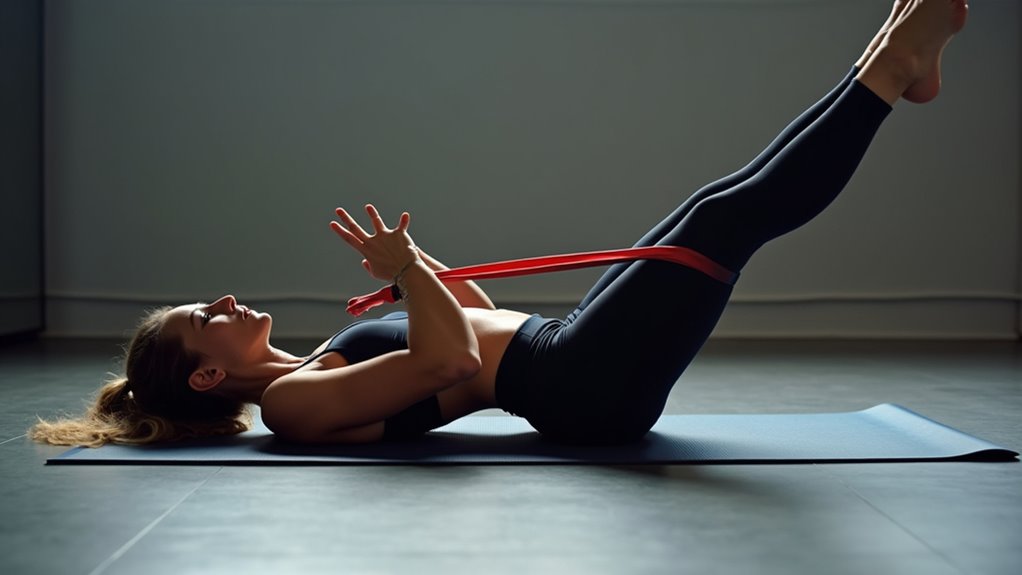
Picture your back muscles like a foundation that’s been neglected—hunched shoulders from desk work, that persistent ache from poor posture, and a core that’s, well, let’s be honest, probably weaker than it should be.
Your back foundation is crumbling from desk slouching and neglect—time to rebuild what years of poor posture have weakened.
The Superman with resistance band is like adding reinforcement to that foundation. You’re lying face down, band looped around your ankles, lifting those legs up high and holding for two counts. It’s actually pretty straightforward—no fancy equipment needed.
- Builds lower back strength while improving spinal alignment
- Counteracts forward head posture from computer work
- Strengthens core muscles that support proper positioning
Resistance Band Good Morning for Posterior Chain Development

Think of the resistance band good morning as hitting the reset button on your entire back side—it’s probably one of the most underrated moves for building that posterior chain strength. You’ll stand on the band with feet hip-width apart, loop it around your shoulders. Then you’re bending forward at the hips, lowering your torso until it’s parallel to the ground. The key here is contracting those glutes and hamstrings to pull yourself back up. It’s like building a foundation—you need that solid posterior chain to support everything else. Simple movement, big results.
Resistance Band Sumo Deadlift for Core Stability
While that good morning movement really targets the hamstrings and glutes, the sumo deadlift takes things up a notch by putting your core through its paces—think of it as the difference between reinforcing a wall versus strengthening the entire foundation of a house. The wide stance creates a whole different challenge, actually. You’ll find your abs working overtime to keep everything stable while your lower back gets stronger without the heavy stress.
- Stand on the band’s center with feet wider than shoulder-width apart
- Lower into sumo squat position while keeping your back straight
- Drive through heels to stand up, engaging core throughout the movement
Resistance Band Romanian Deadlift for Targeted Muscle Building
Master the Romanian deadlift with resistance bands, and you’ve got yourself what’s probably the most targeted lower back builder in your toolkit—well, at least when it comes to isolation work. Think of it like fine-tuning your foundation rather than demolishing and rebuilding. You’ll stand on the band with feet shoulder-width apart, keeping those knees slightly bent. The magic happens when you hinge at the hips—not the waist—lowering your torso until it’s parallel to the floor. Keep that back flat and shoulders pulled back. It’s basically teaching your posterior chain to work as one solid unit.
About The Author


