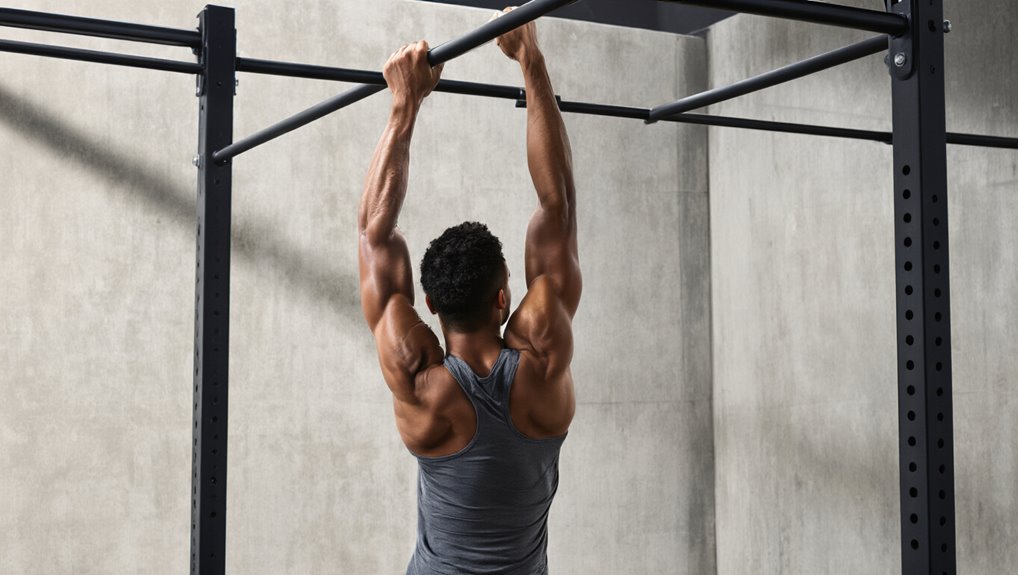
You know, I read somewhere that only about 20% of adults can actually perform a proper pull-up – that’s, well, pretty sobering when you think about it. Maybe it’s because we’ve gotten so used to machines doing the heavy lifting, literally. But here’s the thing: pull-ups are like the ultimate test of your upper body foundation. If you can’t lift your own body weight, you’re probably missing out on some serious functional strength that’ll make every other physical task feel easier.
Some of the links in this article may be affiliate links. If you make a purchase through these links, we may earn a small commission at no extra cost to you. Thank you.
The Science Behind Pull-Up Muscle Activation

When you grip that pull-up bar and start hauling yourself upward, there’s actually a fascinating chain reaction happening throughout your upper body that most people don’t realize. Think of it like a well-coordinated construction crew – each muscle group has its specific job. Your lats act as the main powerhouse, pulling your arms down like hydraulic pistons. Meanwhile, your rhomboids and traps work as stabilizers, keeping everything square and tight. Your biceps jump in as the heavy lifters, while your forearms grip like a vice. It’s honestly pretty amazing how they all coordinate together.
Primary and Secondary Muscles Engaged During Pull-Ups

The blueprint of pull-up muscle engagement breaks down into two clear categories – primary movers and secondary stabilizers, and honestly, understanding this hierarchy can completely change how you approach your training. Your lats are the main engines here – they’re doing the heavy lifting, literally pulling your body weight upward. Think of them as your primary contractors on this job site. Meanwhile, your biceps, rhomboids, and traps act like the subcontractors, providing essential support but not carrying the full load. Your forearms? They’re basically your grip foreman, keeping everything locked down tight.
Health and Fitness Benefits of Regular Pull-Up Training

Now that you’ve got the muscle mechanics down pat, let’s talk about what regular pull-up training actually does for your body – and honestly, the benefits go way beyond just building a stronger back.
| Benefit Category | Primary Impact | Real-World Application |
|---|---|---|
| Strength & Power | Upper body strength gains | Easier lifting, carrying heavy objects |
| Health & Wellness | Improved posture, reduced back pain | Better daily movement, less discomfort |
| Functional Fitness | Enhanced grip strength, core stability | Rock climbing, martial arts performance |
You’ll notice improved posture almost immediately. Your grip strength becomes rock-solid, making everyday tasks feel effortless.
Essential Variations to Maximize Your Pull-Up Routine
Several pull-up variations can transform your basic routine into an extensive upper-body workout that targets muscles from different angles. Wide-grip pull-ups hammer your lats harder, while close-grip chin-ups really fire up those biceps. Think of it like using different tools for different jobs – you wouldn’t use a hammer for everything, right? Commando pull-ups add a tactical twist, alternating sides as you pull up. L-sits during pull-ups engage your core like crazy. Actually, I’d say archer pull-ups are probably the toughest variation – they’re basically one-arm pull-ups in disguise. Mix these in, and you’ll never get bored.
Building Grip Strength and Upper Body Power Through Pull-Ups
Beyond mastering different pull-up variations, you’ll discover that this exercise becomes your secret weapon for developing crushing grip strength and serious upper-body power. Think of your hands as clamps—the longer you hang, the stronger they become. Each rep forces your forearms to work overtime, building that vise-like grip that’s gold for any manual work.
Your lats and biceps? They’re getting hammered too. Well, actually it’s more like they’re being forged under pressure. Start with assisted pull-ups if you can’t do full ones yet. Don’t rush it—building real strength takes time, not shortcuts.
About The Author


