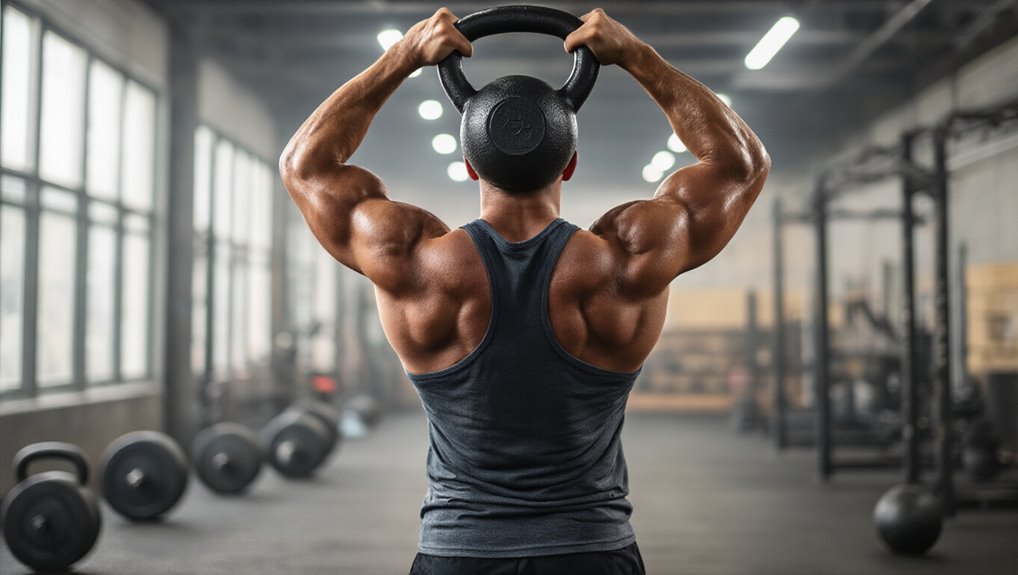
Most people don’t realize their back’s actually like a complex scaffolding system – you’ve got your surface muscles doing the heavy lifting while deeper stabilizers keep everything from collapsing. Well, kettlebells hit both layers in ways that, frankly, traditional gym equipment can’t match. The swinging motion forces your entire posterior chain to fire together, creating real-world strength that transfers beyond the gym. But here’s where most folks mess up completely…
Some of the links in this article may be affiliate links. If you make a purchase through these links, we may earn a small commission at no extra cost to you. Thank you.
Understanding Your Back Anatomy for Optimal Training

Think of your back like the frame of a house – it’s the structural foundation that supports everything else, and understanding its construction is essential before you start any serious renovation work. Your spine’s basically a stack of vertebrae, kind of like concrete blocks, with cushioning discs between them. Now, you’ve got two main layers of muscles working here. The superficial ones – your trapezius and latissimus dorsi – are like your exterior siding. They’re visible and handle the big movements. Underneath, you’ll find the deep stabilizers: erector spinae and multifidus muscles. These are your structural beams, keeping everything aligned and stable.
Essential Benefits of Kettlebell Back Training
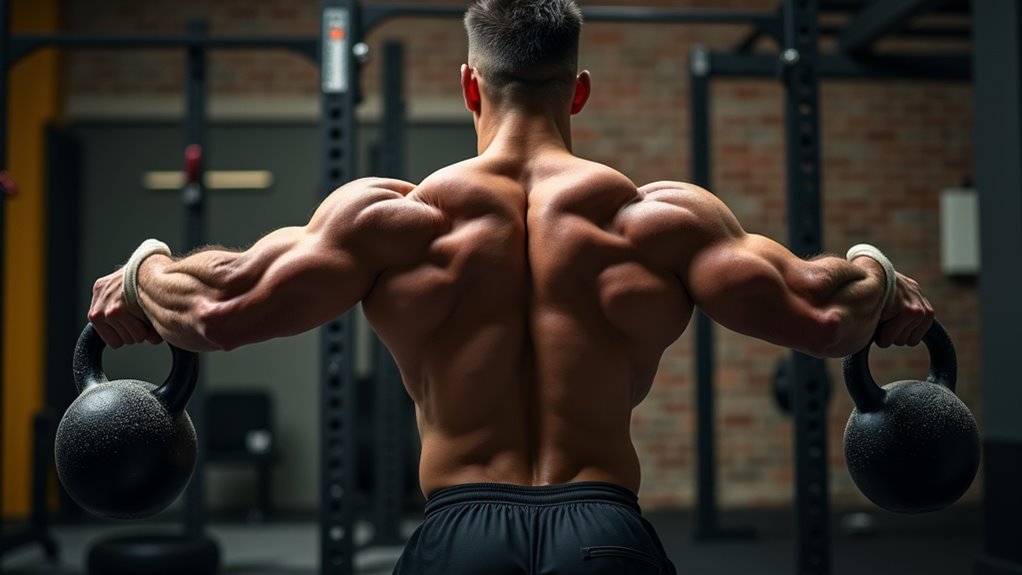
Now that you’ve got the blueprint of your back’s architecture, let’s talk about why kettlebells are probably the best tool in your workout toolbox for building that structure. Think of kettlebells like a multi-purpose power tool – they don’t just target one muscle, they fire up your entire posterior chain. You’re getting strength, stability, and cardio all rolled into one efficient package. The offset weight forces your core to work overtime, which means better posture and less chance of injury down the road. It’s like reinforcing the foundation while building the walls.
Mastering the Kettlebell Single Arm Deadlift

Picture the kettlebell single arm deadlift as the foundation pour of your back training – it’s where everything solid starts. This exercise builds your posterior chain like constructing a strong framework – you need each beam properly placed.
Start with the kettlebell beside your foot, not in front. Hinge at your hips like closing a toolbox, keeping that spine straight as a level. Grab the handle, drive through your heels, and stand tall. The free arm? Well, it’s your balance beam.
Keep the weight close to your body – think of it as carrying a valuable tool. Perfect your form first.
Building Balance With Single Leg Kettlebell Deadlifts
While mastering the single arm deadlift gives you a solid foundation, the single leg version – well, it’s like working on a ladder with one foot on the ground. You’re basically building balance while strengthening your posterior chain.
This exercise targets hip stability and coordination. Here’s what it develops:
| Muscle Group | Primary Benefit | Performance Impact |
|---|---|---|
| Glutes | Hip strength | Better athletic power |
| Hamstrings | Flexibility | Improved movement |
| Core | Stability | Injury prevention |
| Calves | Balance | Coordination boost |
| Lower back | Support | Posture enhancement |
Start light – maybe half your normal deadlift weight. Focus on controlled movement rather than heavy loads initially.
Powering Through Two-Handed Kettlebell Swings
The kettlebell swing transforms fitness routines like a power tool upgrade – it’s probably the most efficient bang for your buck in any workout arsenal. Think of it as your compound miter saw for back development. You’re hinging at the waist, not squatting down – that’s a rookie mistake I see all the time. The kettlebell drops toward your feet like a pendulum, then your hips fire forward with explosive power. It’s actually more about hip drive than arm strength, which surprises most folks. This movement builds your posterior chain while torching calories simultaneously.
Developing Upper Body Strength With Kettlebell Rows
Mastering kettlebell rows builds upper body power like adding a new tool to your workshop – suddenly you’ve got the right equipment for the job. You’ll grip one kettlebell in each hand, maintaining that overhand grip like you’re holding heavy lumber. Keep your spine straight – think of it as your foundation that can’t shift. Pull those kettlebells toward your ribs, engaging your back muscles the same way you’d brace for lifting something substantial. Your elbows stay close, shoulders pulled back. It’s actually pretty straightforward once you get the rhythm down and focus on controlled movement.
Advanced Movements: High Pulls and Renegade Rows
Once you’ve got the basic row down solid, kettlebell high pulls and renegade rows are like upgrading from a standard drill to a hammer drill – they’ll demand more from your entire body but deliver results you can actually feel. High pulls are explosive movements that’ll fire up your power development. Start with feet hip-width apart, hinge at the hips, then explosively pull that bell toward your shoulder. Renegade rows? Well, they’re basically planks with attitude. You’ll hold plank position on two kettlebells, alternating rows while fighting to keep your core steady. Both movements demand respect and proper form.
Safety Guidelines for Injury-Free Kettlebell Training
Approaching kettlebell training without a safety plan is like trying to wire a house without turning off the breaker – you might get lucky, but you’re probably going to get hurt.
Smart kettlebell training starts with proper form – no shortcuts, no ego lifting. Your spine doesn’t forgive sloppy technique. Always warm up those cold muscles first; they’re like stiff copper pipes that need heating before bending.
| Safety Essential | Why It Matters |
|---|---|
| Proper Form | Prevents spine injury |
| Gradual Progression | Avoids muscle strain |
| Adequate Warm-up | Prepares joints/muscles |
| Professional Guidance | Guarantees correct technique |
Stop immediately if you feel pain. Listen to your body—it’s the best foreman you’ll ever have.
About The Author


