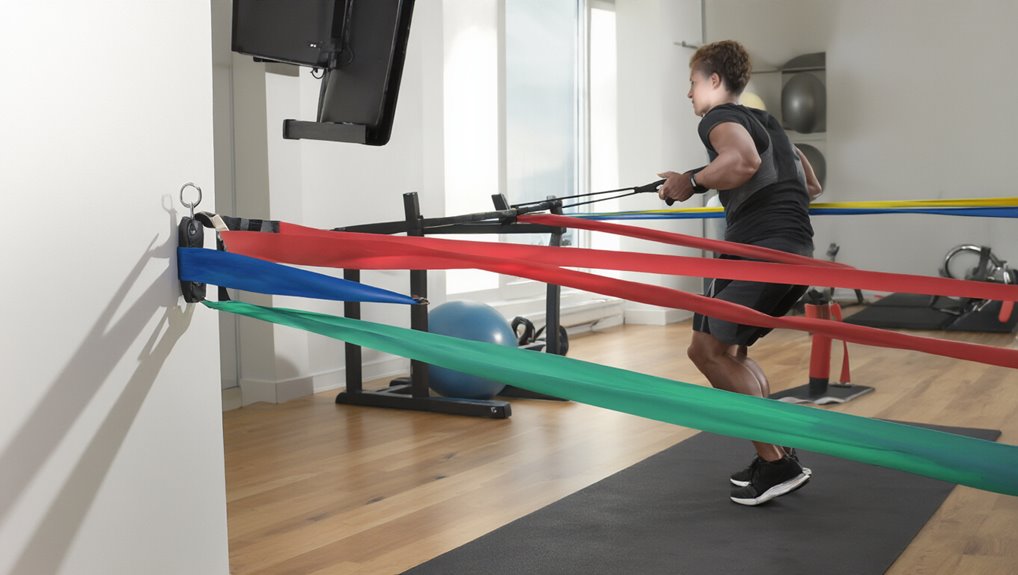
Most people don’t realize their back muscles work like a complex pulley system—and honestly, that’s where resistance bands really shine. You’ve probably noticed how your shoulders round forward after long days, or maybe your lower back aches more than it should. Well, resistance bands can actually rebuild that structural foundation better than you’d expect. The thing is, unlike heavy weights that can strain joints, bands provide variable resistance that matches your body’s natural strength curve. But here’s what most folks miss about proper form.
Some of the links in this article may be affiliate links. If you make a purchase through these links, we may earn a small commission at no extra cost to you. Thank you.
Essential Resistance Band Exercises for Back Development

Several highly effective resistance band exercises can transform weak, underdeveloped back muscles into a strong, well-defined foundation for overall upper body strength. Think of resistance bands as your portable gym – they’re actually more versatile than most people realize. The single arm row targets your lats and rhomboids while improving posture. Seated rows hit multiple muscle groups simultaneously, creating balanced development. Well, lat pulldowns work those hard-to-reach upper back muscles that dumbbells sometimes miss. Band-assisted pull-ups let beginners progress safely without risking injury. These exercises build functional strength you’ll use daily.
Understanding Your Back Anatomy and Muscle Groups

Before you can effectively target your back muscles with resistance bands, you need to understand what you’re actually working with under the hood. Think of your spine like the main support beam of a house – it’s got four key sections. You’ve got your cervical spine up top handling neck movement, thoracic in the middle, lumbar doing the heavy lifting in your lower back, and sacral at the base. The big players are your lats and traps, but don’t overlook the smaller stabilizing muscles. They’re like the screws holding everything together.
Core Strength Enhancement Through Back Training

While most people think of back exercises as purely upper body work, the reality is that your core gets hammered during every single resistance band row, pulldown, and pull-up. Your abs and obliques work overtime to keep you stable when you’re pulling against that band tension. Think of your core as the foundation of a house – without it being rock solid, everything else falls apart. Each rep forces those deep stabilizer muscles to fire up, creating a stronger base for daily activities. It’s like getting two workouts in one, honestly.
Improving Posture and Spinal Stability
That rock-solid core you’re building becomes the foundation for something even more transformative – actually fixing your posture and stabilizing your spine. Think of your spine like the main beam in a house – without proper support, everything starts sagging. Resistance band exercises work those deep stabilizer muscles that act like internal scaffolding. When you’re pulling against that band tension, you’re training your body to hold itself upright naturally. It’s not just about looking taller (though that’s nice). You’re literally rewiring how your muscles support your spine, reducing that nagging back pain from hunching over desks all day.
Flexibility and Range of Motion Benefits
Stretch that resistance band overhead and you’re doing something most people don’t realize – you’re actually lengthening your spine like pulling a compressed spring back to its natural state. Regular resistance band work creates flexibility that’s, well, pretty remarkable. Your vertebrae start moving more freely, and honestly, it’s like oiling a rusty hinge. The bands force your muscles through their full range of motion, which – I think most people don’t realize this – prevents that stiffness we get from sitting all day. It’s basically maintenance for your back, keeping everything loose and functional.
Mental Health and Stress Reduction Through Exercise
Focus on those controlled resistance band movements and something interesting happens – your mind actually starts to calm down. It’s like your brain hits a reset button when you concentrate on proper form and breathing. The repetitive motions create a meditative rhythm that pushes stress aside.
| Exercise Type | Mental Benefit | Time to Notice |
|---|---|---|
| Single Arm Row | Increased Focus | 2-3 sessions |
| Lat Pulldowns | Reduced Anxiety | 1-2 weeks |
| Seated Rows | Better Sleep | 3-4 weeks |
Regular resistance training doesn’t just build muscle – it builds mental resilience too.
Progressive Training Techniques and Proper Form
Building that mental toughness through resistance band work is great, but honestly, you’ll hit a wall pretty fast if your form’s sloppy – and trust me, I’ve seen plenty of people plateau because they rushed ahead without nailing down the basics first.
Think of proper form like your foundation – you wouldn’t frame a house on shaky ground, right? Start with lighter resistance and focus on controlled movements. Master the single-arm row before attempting pulldowns. Progress gradually by increasing band tension or reps, not both simultaneously. Quality beats quantity every time in resistance training.
Maximizing Results With Consistent Band Workouts
Consistency becomes the game-changer when it comes to resistance band training – you can’t expect to see real results from sporadic workouts here and there. Building back strength is like constructing a solid foundation; you need to show up regularly and put in the work.
- Schedule 3-4 sessions weekly – Your muscles need regular stimulus to adapt and grow stronger over time.
- Track your progress – Write down reps, sets, and band resistance levels to monitor improvements.
- Gradually increase intensity – Add tension or reps every two weeks to challenge your muscles.
- Stay patient – Real strength gains typically show after 6-8 weeks of consistent training. Additionally, incorporating high-intensity interval training (HIIT)(https://example.com) can further enhance your overall metabolic health and support your resistance band workouts.
About The Author


